
Development of a Structural Composite Access Mat
Traditional timber access mats performed the job, but they rotted. The objective was a reusable composite mat that would resist rot and match wood in the field.
Engineering Case Study 005
- Industry
- Heavy-Duty Access / Ground Protection
- Product
- 14 ft × 8 ft × 4 in structural composite mat
- Role
- Product & Manufacturing Development
- Engagement
- New Product Development / Full-Scale Validation
- Target
- ~1,000 lb; 200 psi load target; 7-year service life
The Situation
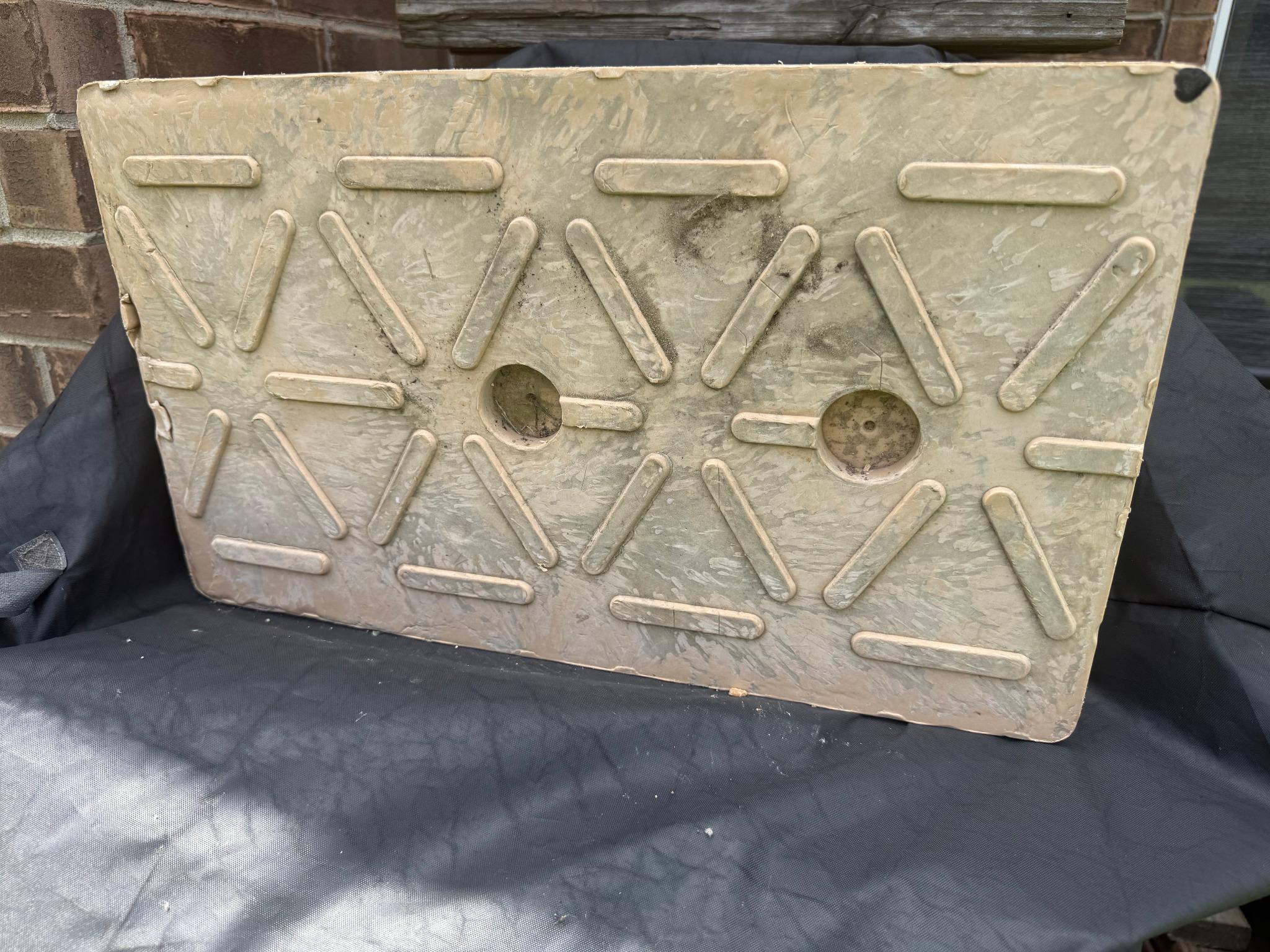
Traditional timber access mats performed the job, but they rotted. The development objective was a reusable composite mat that would resist rot while at least matching the field performance of wood. The target product was approximately 14 ft × 8 ft × 4 in, about 1,000 lb, forklift-handled, and intended for a seven-year service life.
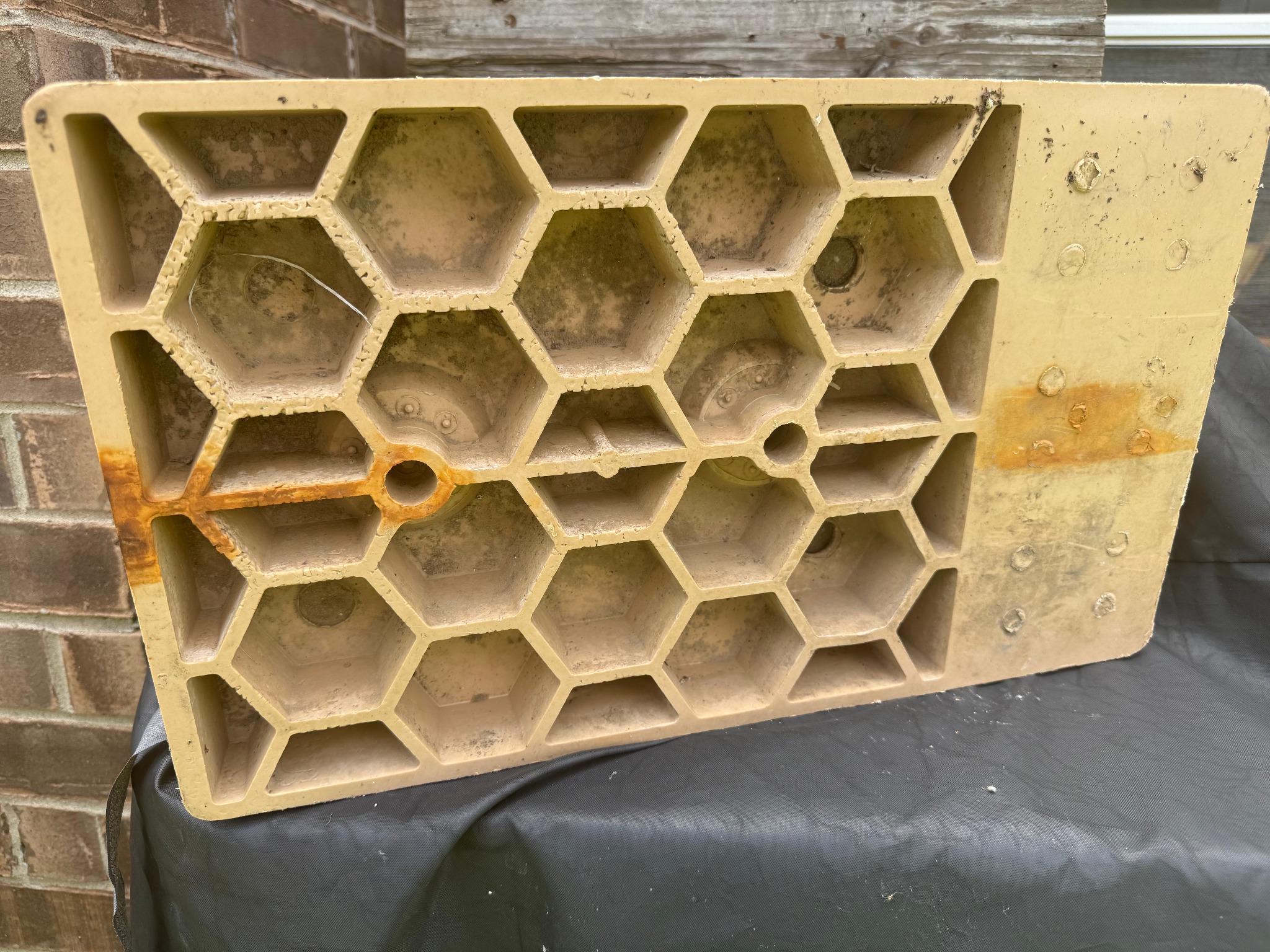
The concept evolved from an early plastic/rubber extruded-board approach into two mirror-image compression-molded panels assembled into a honeycomb sandwich structure. Recycled plastic was initially attractive, but its variability produced brittle cracking. The program moved toward virgin UHMW HDPE and a controlled formulation.
The Engineering Challenge
The product had to behave in contradictory ways: rigid enough to support heavy traffic, yet tough enough to flex without cracking. Material formulation alone could not provide the answer; the internal structure had to carry part of the job.
The developed geometry used approximately 1/2-in skins, 1/8-in surface treads, 2.25-in honeycomb cells with tapered walls, and solid edge regions that became overlapping lips. Those lips supported mat-to-mat joints so traffic would not pump unsupported edges into soft ground.
- Material formulation, stabilizers and warpage-control additives had to work with the molded geometry.
- Cell configuration and skin thickness were developed as part of the structural solution.
- Development progressed from a 12 × 18 × 2.18-in laboratory part, to pallet scale, and finally to full-size tooling.
Development & Testing
Early prototypes were either brittle or too flexible. Dozens of grades, blends, fillers and assembly approaches were tested. Full-scale rigidity was first checked by supporting a mat and driving a forklift onto the suspended section while measuring deflection. That test showed stiffness, but it did not show toughness or how the product would ultimately fail.
A separate engineer designed a full-scale three-point bending fixture that became known as the Heartbreak Machine. The mat rested on two supports eight feet apart while a beam at midspan loaded the full width through a hydraulic cylinder. The test captured force, movement and deflection. Roughly 25 major formulations or prototypes were tested; unsuccessful versions commonly cracked or split in the lower panel.
During the breakthrough test, the mat continued to carry load until the 1.5-in hydraulic cylinder rod folded. Based on a 6-in bore cylinder loaded on the gland side at a 2,200 psi pump pressure, the theoretical hydraulic force was approximately 58,316 lbf (about 29.2 tons). The exact pressure at the instant of failure was not recorded. The significance was clear: the latest polymer/structure combination had become sufficiently strong and tough that the test fixture failed first.
Commercialization
The product went directly into commercial service rather than waiting for a mature qualification history. Initial production was approximately 70 mats per day. Newpark Mats marketed the product first into oil and gas, with later use expanding into power and other commercial construction. Field complaints became additional engineering inputs and drove subsequent product improvements.
The basic mat ultimately carried at least four patents, with additional improvement patents obtained over later years.
Results
| Area | Result |
|---|---|
| Original problem | Timber mats rotted in service. |
| Development path | Extruded concept → molded honeycomb sandwich → controlled virgin-polymer formulation. |
| Scale-up | 12 × 18-in lab part → pallet scale → 14 × 8-ft production mat. |
| Validation | ~25 major iterations plus full-scale bending tests. |
| Breakthrough | Mat survived until the hydraulic test-machine rod folded. |
| Initial production | ~70 mats/day. |
| Commercial use | Oil & gas, later power and commercial construction. |
| IP | At least four patents on the basic mat; later improvement patents. |
Engineering Significance
Designing the mat required the material, structure, molding process and assembly method to be treated as one system. The central development discipline was simple: design it, test it until the weakness is exposed, correct that weakness, and repeat until the product—not the assumption—proves the answer.